
Tech-Enabled Services vs. SaaS: Why Gross Margin Sets Your Valuation
Some companies look like software in the pitch deck but behave like services in the financials. It is a pattern investors see often in services-enabled tech businesses, and it is worth being honest about prior to your first fundraise.
The transition that doesn't always happen
The vision is usually clear: build a platform, layer in services to land the first customers, then move to scalable software delivery over time. The problem is that the transition does not always happen.
Every new customer requires custom implementation. Headcount grows in proportion to revenue. The margin profile stays flat or compresses even as the top line scales. The business is growing, but it is growing like a services firm, not a software company.
Where the difference shows up: gross margin
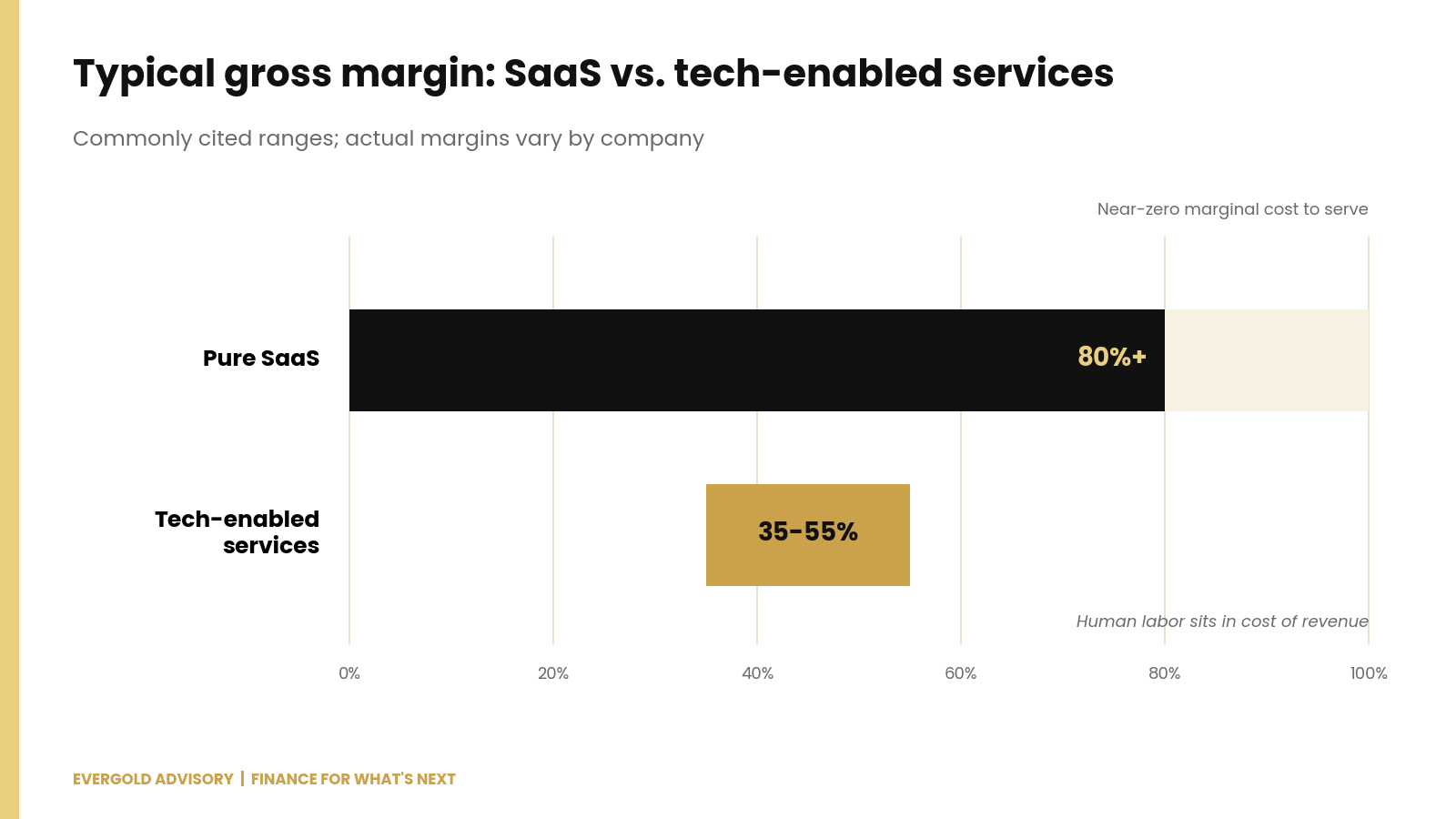
The cleanest way to see which business you run is gross margin.
Pure SaaS: commonly 80% or higher, with near-zero marginal cost to serve one more customer.
Tech-enabled services: commonly 35-55%, because human labor sits directly in cost of revenue.
Calling a services company a software company does not change how venture funds and public markets value it. If software is not automating delivery, your multiple is capped by your gross margin profile.
Why this matters
Services and software businesses are valued differently, funded differently, and managed differently.
Valuation: investors apply revenue multiples based on margin quality and scalability, not on the label in the deck.
Funding: a business that needs people to deliver growth needs more capital per dollar of revenue than one that does not.
Management: hiring plans, pricing, and cash forecasts all behave differently when delivery is human.
There is nothing wrong with running a profitable services-enabled business. The risk is planning and spending as if software margins are coming when the financials do not support that assumption.
Three signs the financials look like services
Custom implementation for every customer. If onboarding cannot be repeated without engineering or consulting time, it is a service.
Headcount tracks revenue. If you hire a delivery person for every few customers added, margins will not expand with scale.
Gross margin is flat or shrinking while revenue grows. Scale should help margins. If it does not, delivery cost is the reason.
The question I ask founders
What percentage of your revenue requires human delivery today, and what is the realistic path to changing that number?
If the honest answer is "most of it, and we are not sure," that is useful information. It tells you what to fix first, and it tells you how to talk to investors.
How to build the plan around what the business actually is
Split revenue by type. Report software revenue and services revenue separately, with gross margin for each.
Set a software-delivery target. Pick the share of revenue that should be delivered without custom labor in 12 months and track it quarterly.
Price implementation on its own line. Services should cover their cost, not hide inside a subscription.
Model both cases. Build a forecast at today's margin and another at your target margin, with hiring tied to revenue in each.
Tell investors the real story. A credible services-to-software roadmap with measured progress is more fundable than a software label the numbers cannot support.
Bottom line
Build the plan around what the business actually is today and measure the path to what you want it to become. If you would like help separating revenue streams, building a margin-by-stream view, or preparing this story for investors, our fractional CFO team works with founders at exactly this stage. Get in touch.