
If your company grants stock options, the exercise price has to be set at fair market value. A 409A valuation is how most private companies support that number. Getting it wrong is not a paperwork problem. It can create tax consequences for the people you are trying to reward.
What a 409A valuation is
A 409A valuation is an independent appraisal of the fair market value of a private company's common stock. Section 409A of the Internal Revenue Code governs deferred compensation. Options granted with an exercise price below fair market value can be treated as deferred compensation that fails the rules, which can expose option holders to income tax, an additional 20% federal tax, and interest.
A valuation prepared by a qualified independent appraiser carries a presumption of reasonableness with the IRS, which is why most startups use one.
When you need a new 409A
Before your first option grant. You need a fair market value to set the strike price. For a startup that just incorporated, this may presumably be $0 before any fundraise or revenue occurs.
After a material event. A priced financing, a significant contract, a change in revenue trajectory, an acquisition offer, or a major change in the business can all make an older valuation stale.
At least every 12 months. The presumption of reasonableness generally depends on the valuation being no more than 12 months old and no material event having occurred since.
Because timing matters, many companies order a new valuation shortly after closing a round and before granting new options.
Why the 409A is lower than your last round price
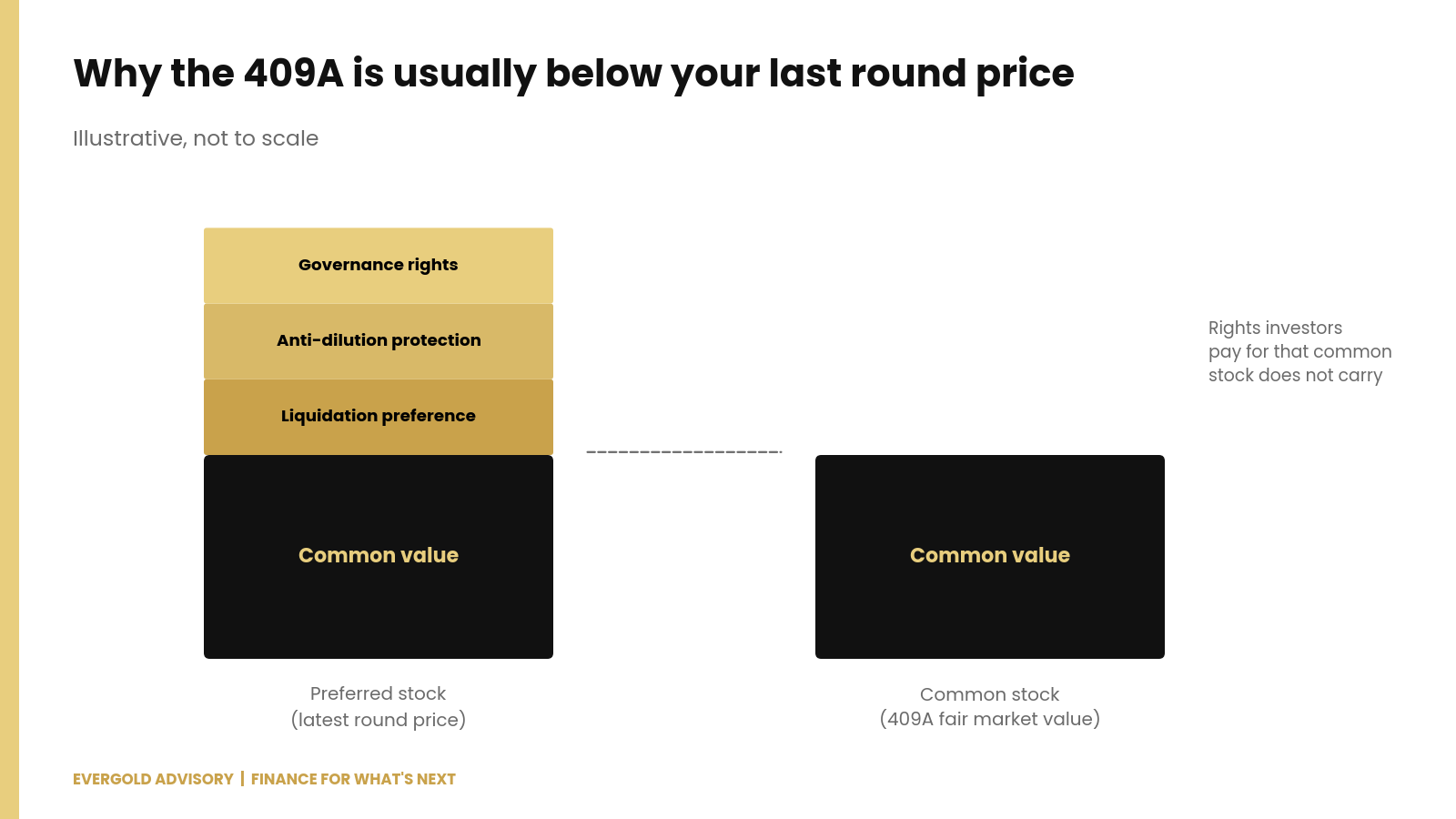
This surprises many founders. Investors in a financing typically buy preferred stock, which carries rights that common stock does not: liquidation preference, anti-dilution protection, and often governance rights. Employees hold common stock. A 409A values common, so the number is usually a fraction of the preferred price. The gap narrows as the company matures and the likelihood of a liquidity event increases.
What drives the result
Stage and financial performance: revenue, growth, margins, burn, and runway
Capital structure: the rights and preferences of each class of stock, and how value flows to each in different outcomes
Recent transactions: the price and terms of your latest financing
Market comparables: valuation multiples of similar public companies or recent transactions
Forecast quality: supportable projections and the assumptions behind them
Marketability: a discount applied because private shares cannot be sold freely
Appraisers typically use market, income, and cost approaches, then allocate value across the classes of stock. The right mix depends on the stage of the company and the data available.
What to give your valuation provider
Current cap table and option ledger
Charter and financing documents showing stock rights
Financial statements and the current forecast
Details of recent financings and any acquisition interest
A summary of material developments since the last valuation
Clean records speed the process and support the conclusion. Weak documentation tends to raise questions rather than lower the price.
Common mistakes
Using an old valuation after a financing or major milestone
Granting options before the new valuation is delivered
Giving the appraiser a forecast the company is not actually managing to
Treating the 409A as a negotiation instead of an independent analysis
Keeping inconsistent cap table records
Bottom line
Plan the valuation around your financing and grant calendar so you are never granting on a stale number. For a deeper look at how valuation methods and stakeholder expectations work, read our post on business valuations. Evergold prepares valuation analyses for private companies; contact us to discuss timing and scope.
This post is general information, not tax or legal advice. Consult qualified counsel on your specific situation.