
A startup does not need the same finance function at every stage. It needs the right finance support for the risks it is facing right now. Overbuilding too early wastes capital. Underbuilding too long creates problems that compound or even the risk of burning through cash before your next fundraise.
What a fractional CFO does
A fractional CFO provides senior financial leadership on a part-time basis, without the cost or commitment of a full-time executive. Depending on scope, that includes financial modeling and forecasting, cash and runway management, bookkeeping and accounting, board and investor reporting, fundraising support, and building the processes and controls the company will need as it grows.
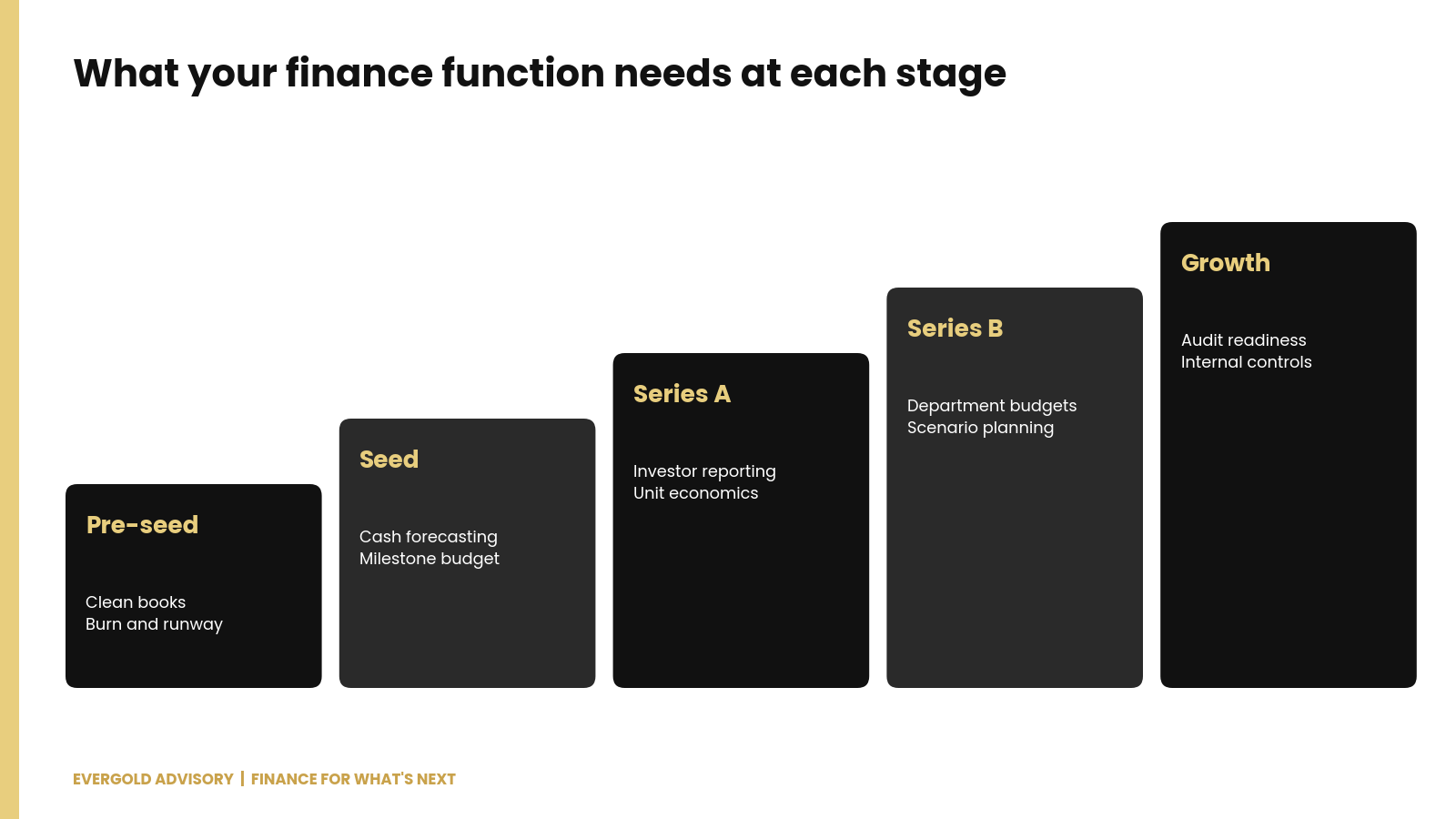
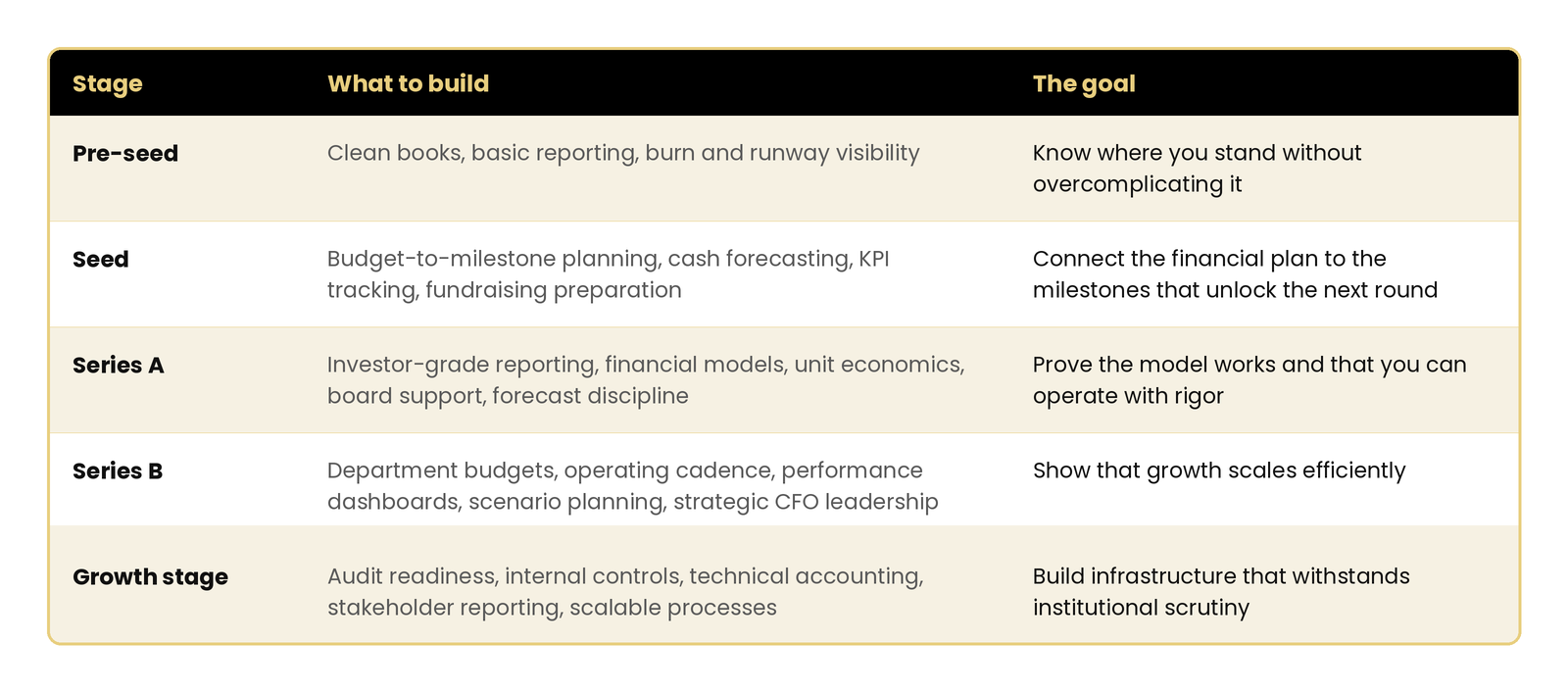
What your finance function needs at each stage
Signs it is time to bring in a fractional CFO
You cannot answer your runway question quickly. If cash-out date and burn require a spreadsheet hunt, the feedback loop is too slow.
A fundraise is within six to nine months. Investor-ready models and clean reporting take longer to build than most founders expect.
Investors ask questions the books cannot answer. Unit economics, cohort data, and forecast variance come up early in diligence.
Finance runs on founder time. If you are reconciling accounts or building models yourself, that is time not spent on product or customers.
You are approaching an audit, a valuation, or a transaction. These events reward preparation.
Fractional CFO, controller, or bookkeeper?
These roles solve different problems.
Bookkeeper: records transactions accurately and keeps the ledger current.
Controller or accounting lead: owns the monthly close, reconciliations, and financial statements.
Fractional CFO: uses that data to guide decisions on hiring, spending, fundraising, and capital allocation.
Most early-stage companies need all three functions, even if one team delivers them. The mistake is expecting a bookkeeper to do the work of a CFO, or paying for a CFO to do data entry.
What drives the cost
Fractional CFO engagements are scoped to the company rather than sold at a flat rate. The main drivers are the stage of the business, the volume and complexity of transactions, whether accounting and reporting are included or handled elsewhere, and how much fundraising or board support is needed. A seed-stage company with clean books needs a different engagement than a Series B company with a multi-entity reporting structure.
What to look for in a fractional CFO
Senior-led delivery. Confirm who will actually do the work, not just who sells it.
Venture Capital experience. Fundraising, board reporting, and investor diligence are different from general small-business accounting.
Both strategy and execution. You want someone who can build the model and keep the reporting running.
A plan that scales. The engagement should grow with the company without a restart.
Bottom line
Build what you need now, build it well, and make sure it positions you for the next stage. If you are weighing whether a fractional CFO fits where your company is today, see how we work with founders or start a conversation.